
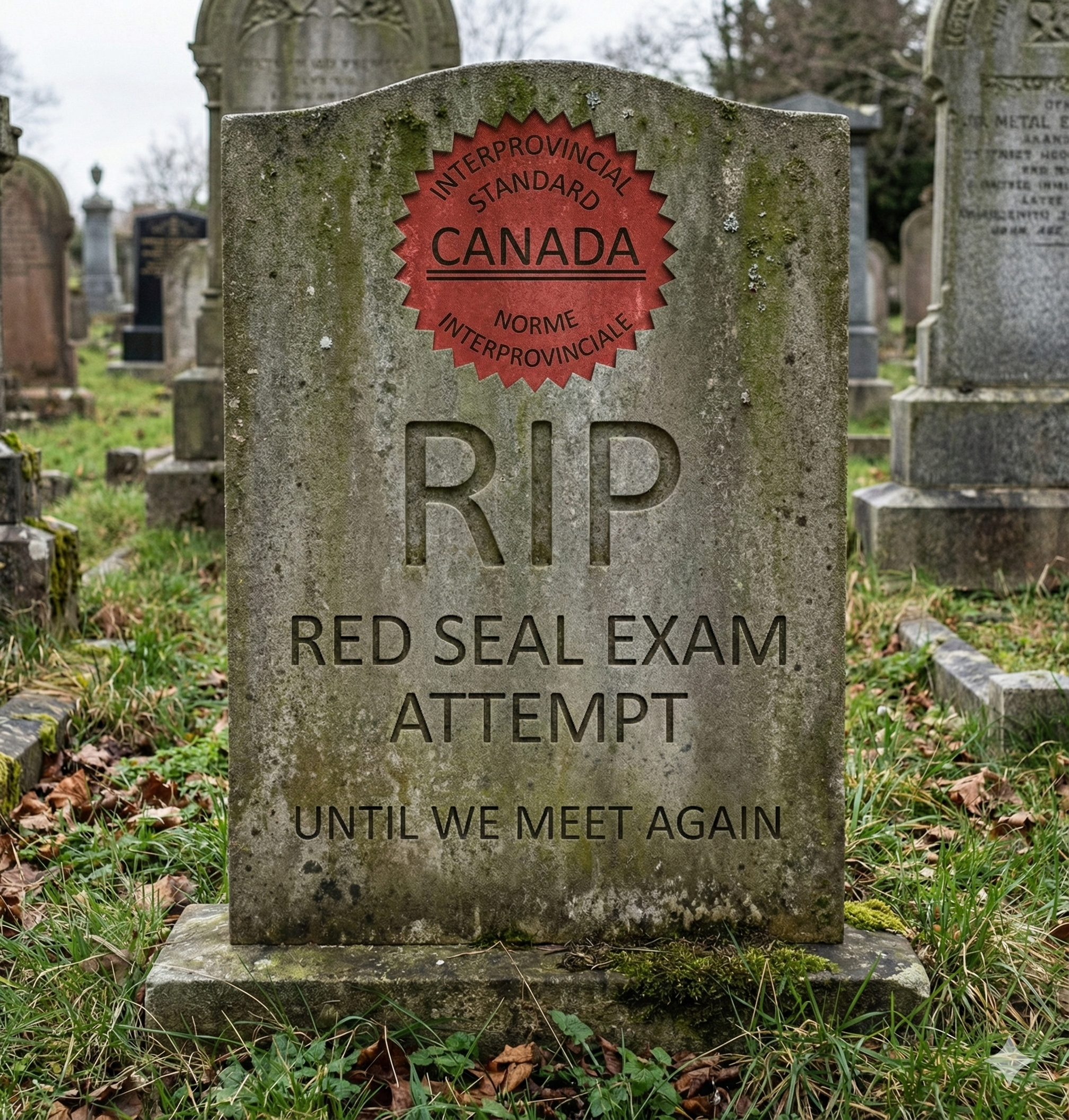
Why People Fail the Red Seal Exam on the First Attempt
And how to build a study plan that actually works
The Red Seal exam is not a “did you read the book?” test. It’s a performance test. It measures whether you can recall trade knowledge, apply it to job-like scenarios, and choose the best answer under pressure.
If you’re preparing for your first attempt, here are five common failure points. Each includes what to change using a smarter study plan, better practice questions, and a realistic practice exam approach.
1) Inadequate preparation or “busy studying” instead of exam-ready studying
This is the #1 cause because it’s easy to feel prepared while still missing the ability to retrieve and apply knowledge on demand.
What it looks like
- Hours of reading, highlighting, and watching videos
- Confidence during study sessions, then a crash when you face timed questions
- “I knew this yesterday” moments on exam day
Why it happens
Passive review builds familiarity, not performance. The exam rewards what you can pull from memory quickly and apply correctly.
Fix it
- Build your study plan around practice questions early and often
- Track weak areas and loop back with targeted review
- Don’t wait until the end to do timed work
2) Not fully aligning to the Red Seal curriculum
A lot of candidates don’t fail because they’re unskilled. They fail because they studied broadly, while the exam follows a specific scope and weighting.
What it looks like
- Over-studying favorite topics and under-studying high-weight areas
- Getting surprised by question types and topic emphasis
- Using resources that are “trade-related” but not aligned to the exam
Why it happens
If you don’t build your study plan from the Red Seal curriculum, you risk spending time on low-yield content and missing core competencies.
Fix it
- Start with the Red Seal curriculum (your content outline)
- Allocate study time based on weighting, not comfort
- Create a checklist of objectives and map your resources to them
3) Weak multiple-choice execution and time management
Even when you know the content, you can lose marks through avoidable execution errors.
What it looks like
- Misreading keywords like “best,” “most likely,” “except,” “next step”
- Falling for distractors that sound right but don’t meet the stem
- Spending too long early and rushing late
Fix it
- Use a consistent method: read the stem, predict the answer, then check options
- Practice pacing: timed sets now, not later
- Train decision-making under uncertainty (you won’t feel 100% on every item)
4) Anxiety and pressure that disrupt performance
Test anxiety can hijack attention, speed, and confidence. It often shows up as second-guessing and mental blanks.
What it looks like
- Racing thoughts, tight chest, “I can’t think”
- Changing answers repeatedly
- One hard question derails the next ten
Fix it
- Do at least one full practice exam under realistic conditions
- Build a reset routine: slow breath, posture reset, re-read the stem
- Rehearse the day: sleep, food, timing, breaks, and what you do when you panic
5) Hidden constraints: attention issues, sleep debt, and life overload
This is less common than the first four, but it’s a silent killer when it applies.
What it looks like
- You sit down to study and your brain slides off the material
- You “study for hours” but little sticks
- You reread the same paragraph or question multiple times
- You’re exhausted, inconsistent, and behind schedule
Fix it
- Treat sleep like part of the study plan
- Study in short, structured blocks with a clear objective (not “study chapter 6”)
- If attention issues are persistent, consider screening/support—tools and strategies can change everything
A simple Red Seal study plan that reduces failure risk
And how our course already does it for you
You can build this study plan yourself. Or you can follow our course, which already runs these phases in a guided pathway aligned to the red seal curriculum.
Phase 1: Build the map (Days 1–3)
- Our course starts with the red seal curriculum for your trade.
- High-weight domains are highlighted so you focus on what moves your score.
- A built-in tracker sorts topics as Strong / Medium / Weak as you progress.
Phase 2: Learn + test (Weeks 1–4+)
- Daily lessons pair short review with targeted practice questions.
- Weekly timed mixed sets build pacing, endurance, and decision-making for the red seal exam.
- Your weak-topic list updates automatically, so your study plan stays focused.
Phase 3: Simulate (Final 1–2 weeks)
- You complete one to two full practice exam simulations under realistic conditions.
- Misses are reviewed by type: knowledge gap, misread, reasoning error, or rushing.
- Then you get focused drills to fix the pattern, not just the question.
If you want this structure without building it from scratch, our course delivers the full study plan, keeps you aligned to the red seal curriculum, and prepares you for the red seal exam.