
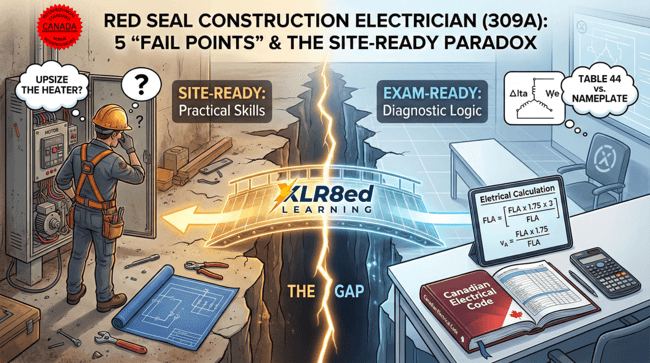
Red Seal Construction Electrician (309A): 5 Exam “Fail Points” That “Trip” Apprentices
The “Lead Hand” Trap
You’ve accumulated 9,000 hours as a Red Seal Construction Electrician (309A). You’ve pulled Teck cable through the frozen oil sands and bent rigid conduit for high-rises in downtown Toronto. Your foreman calls you a “lead hand.” You are safe, efficient, and productive.
But that doesn’t mean you will pass the Red Seal. Statistics from provincial authorities reveal a pass rate hovering between 55% and 65%. Why? Because the Red Seal exam isn’t a test of your manual dexterity; it is a rigorous assessment of diagnostic logic and theoretical competence.
If you try to answer exam questions based solely on “how we do it on site,” you will likely fail.
The “Site-Ready vs. Exam-Ready” Paradox
At XLR8ed Learning, we call this the “Site-Ready Paradox.” The daily tasks of a fourth-year Red Seal Construction Electrician (309A) apprentice—layout, rough-in, and device installation—make up less than 30% of the exam’s cognitive load (based on 2021 RSOS Weightings). The exam focuses heavily on what you don’t do every day: complex motor control logic, transformer sizing, and hazardous location classification.
RSOS Weighting

Hurdle #1: Motors & Control Systems (MWA D)
The Red Seal exam requires you to troubleshoot complex scenarios. If a 3-phase motor keeps tripping an overload relay, simply “upsizing the heaters” (as an apprentice might suggest on-site) will lose you the mark.
The Trap: Candidates constantly mix up Overcurrent Protection (wire protection) with Overload Protection (thermal motor protection).
- Overcurrent: Uses Table 44 FLA values.
- Overload: Uses Nameplate FLA values.
The “Math Class” Protocol: Sizing the Fuse
- The Formula: Time Delay Fuse = FLA (Table 44) x 1.75
(See CEC Table 29 for multipliers).
- The Scenario:
Calculate the maximum Time Delay Fuse for a 25 HP, 575V, 3-phase induction motor.
- The Step-by-Step:
- Find FLA: Go to Table 44. 25 HP @ 575V = 27 A.
- Calculate: 27 A x 1.75 = 47.25 A.
- Select Standard Size: Code rules dictate you do not exceed the calculated value. The standard size below is 45 A.
4. The Common Trap: Using the Nameplate current provided in the question text instead of Table 44 for conductors and fuses.
Hurdle #2: Transformers (MWA B)
Transformers are “Invisible Theory.” In the field, they arrive pre-engineered; on the exam, you are the engineer. You must master Delta-Wye transformations.
- Delta Connection: Line Voltage = Phase Voltage
- Wye Connection: Line Voltage = Phase Voltage x 1.732
Red Seal Radar: MWA B (Distribution) accounts for 28% of your exam. Expect these to be Calculation & Code Referencing questions rather than simple recall. If you aren’t sure of the difference, read our [guide to Red Seal exam multiple choice questions] to understand exactly what the examiners are looking for.
Hurdle #3: Grounding vs. Bonding (Section 10)
On site, everything green is a “ground wire.” On the exam, Grounding and Bonding are two physically different functions sized by different tables.
- Grounding: Connecting the system neutral to earth. Sized by Table 17 based on conductor size.
- Bonding: Connecting metallic parts back to the source to trip the breaker. Sized by Table 16 based on the overcurrent device rating.
Book vs. Reality: On the job, you might just grab a #6 for everything. On the exam, using Table 17 when they asked for a bonding conductor will cost you the pass.
Hurdle #4: Hazardous Locations (Section 18)
This is often pure memorization because many apprentices lack “site memory” of specialized zones. You must know the Zone System (0, 1, 2).
- Zone 0: Continuous hazard (e.g., inside a fuel tank).
- Zone 1: Intermittent hazard (present during normal operation).
Zone 2: Abnormal hazard (only present during accidental rupture/failure).
Hurdle #5: Circuit Analysis (The Broken Neutral)
The Scenario: A 3-wire 120/240V circuit loses its neutral. A 1000W heater is on Line 1, and a 100W TV is on Line 2. The TV explodes.
The Logic: Without a neutral, the loads are in Series across 240V. The voltage divides based on resistance; the load with higher resistance (the smaller wattage TV) receives the higher voltage (well over 200V) and burns out.
The Tailgate Checklist
- Stop Studying What You Know: If you can rough-in a house in your sleep, stop reviewing Section 12.
- Master Table 44: Never use nameplate data for conductor sizing in motor calculations.
- Know Your Zones: Memorize Zone 0/1/2 definitions for gases and dusts.
Respect Section 10: Understand the difference between sizing a Grounding conductor (Table 17) and a Bonding conductor (Table 16).
Ready to jump these hurdles? Check out XLR8ed’s Construction Electrician exam practice questions.
FAQ: Red Seal Construction Electrician (309A) Exam Strategy
Q: What is the pass rate for the Red Seal Electrician exam?
A: The pass rate typically fluctuates between 55% and 65% depending on the province and year. Success rates are significantly lower for challengers (experienced workers who haven’t completed formal apprenticeship training) compared to apprentices who have recently completed technical training.
Q: What is the hardest topic on the Red Seal Electrician exam?
A: Most candidates find Motors and Controls (MWA D) and Power Distribution (MWA B) to be the most difficult sections. While they only make up about 48% of the exam combined, they contain the highest density of complex calculations (motor feeders, transformer sizing) and theoretical logic that isn’t commonly used in daily residential or commercial site work.
Q: How do I size overload protection vs. overcurrent protection for motors?
A: This is a critical distinction for the exam:
- Overcurrent Protection (Short Circuit): You must use CEC Table 44 values to size fuses and breakers.
- Overload Protection (Thermal): You must use the Nameplate FLA of the specific motor to size heater elements.
- Trap: Never use Nameplate FLA for sizing fuses, and never use Table 44 for sizing overloads.
Q: Which Code tables are used for grounding vs. bonding?
A: The tables are as follows:
- Grounding (System to Earth): Use Table 17. Sizing is based on the ampacity of the largest service conductor.
- Bonding (Equipment to System): Use Table 16. Sizing is based on the rating of the overcurrent device (fuse or breaker) protecting that circuit.
Q: Can I use the “100-foot rule” for voltage drop on the Red Seal exam?
A: No. You must calculate voltage drop using the proper formula:
- Single Phase: VD = (2 x L x R x I) / 1000
- Three Phase: VD = (1.732 x L x R x I) / 1000
Always refer to Table D3 in the CEC Appendix for distance correction factors if applicable, but do not rely on “rule of thumb” site math.
Q: How many questions are on the Red Seal Construction Electrician exam?
A: The exam consists of exactly 100 multiple-choice questions. Since you are given 4 hours to complete the exam, this breaks down to approximately 2.4 minutes per question.
Q: What is the difference between Zone 0, Zone 1, and Zone 2 in hazardous locations?
A: The definitions are as follows:
- Zone 0: Explosive gas atmosphere is present continuously or for long periods.
- Zone 1: Explosive gas atmosphere is likely to occur in normal operation.
- Zone 2: Explosive gas atmosphere is not likely to occur in normal operation and, if it does, will exist only for a short time (e.g., accidental leak).
Q: Does the Red Seal exam use the current Canadian Electrical Code?
A: Yes, but there is often a lag. The exam is typically based on the Code version in force when the exam questions were validated. Always check with your provincial apprenticeship authority to confirm which version of the CEC (e.g., 2021 or 2024) is currently being tested.
Red Seal Construction Electrician (309A) Quiz
Motors & Controls (309A) Topic: Overload vs. Overcurrent Protection Time Limit: 5 Minutes
1. You are sizing the branch circuit conductors and the overcurrent protection (fuses) for a generic 3-phase induction motor. Which current rating MUST you use as the basis for your calculations?
A) The Nameplate FLA stamped on the motor
B) The FLA listed in CEC Table 44
C) The Service Factor Amps (SFA)
D) The Locked Rotor Current
2. A 575V 3-phase motor has a Table 44 current of 27 A. You are installing Time Delay Fuses. What is the maximum rating you can calculate before checking for standard sizes?
A) 81 A
B) 33.75 A
C) 47.25 A
D) 67.5 A
3. Scenario: A 3-phase motor is tripping its Overload Relay. The motor nameplate reads FLA: 24 A. The Table 44 value for this HP is 27 A. What value should be used to size the new overload heaters?
A) 27 A
B) 24 A
C) 30 A
D) 33.75 A
4. What is the minimum ampacity required for the branch circuit conductors supplying a single continuous-duty motor?
A) 100% of the Nameplate FLA
B) 115% of the Table 44 FLA
C) 125% of the Table 44 FLA
D) 125% of the Overload setting
5. If you are calculating the feeder size for a group of motors, how do you determine the total calculated load?
A) Sum of all Table 44 FLAs + 25% of the largest motor’s FLA
B) Sum of all Nameplate FLAs + 50% of the largest motor
C) Sum of the overcurrent device ratings for all motors
D) Sum of all Table 44 FLAs only
Answer Key & Rationale
1. Correct Answer: B
Code Rule 28-106 requires using the values from Table 44 (or Table 45 for single-phase) to size conductors and overcurrent devices. This ensures the system can handle the standard expected current for that horsepower, even if the motor is swapped later.
2. Correct Answer: C
According to Table 29, the maximum setting for a Time Delay fuse is 175% of the motor’s full load current (27 A x 1.75 = 47.25 A).
3. Correct Answer: B
Overload protection is thermal protection for the specific machine installed; therefore, you always use the actual Nameplate FLA (24 A) to size heaters. Using Table 44 would oversize the heater and risk burning out the motor windings.
4. Correct Answer: C
Rule 28-106 states that conductors for a single motor in continuous duty must be rated for at least 125% of the full load current rating (from Table 44) to allow for heat dissipation.
5. Correct Answer: A
Rule 28-108 requires taking the sum of all motor currents (from Tables 44/45) plus an extra 25% of the largest motor to account for the starting stress of the biggest load.