Machinist Exam Formulas: Sine Bar Math for Red Seal Success
On the shop floor, setting up a sine bar is routine. You check the print for the angle, flip open your Machinery’s Handbook (or check an app), find the constant for that angle, and build your gauge block stack. It’s fast, accurate, and efficient.
But on the Red Seal Exam, that efficiency creates a blind spot.
You won’t have your Handbook, your charts, or your phone in the exam room. You will have a calculator and a blank sheet of paper. If you have spent the last 10 years relying on lookup tables, the sudden need to perform trigonometry manually can cause a “brain freeze.” To pass, you need to strip away the chart and master the specific machinist exam formulas behind the tool.
Mastering Machinist Exam Formulas for the Sine Bar
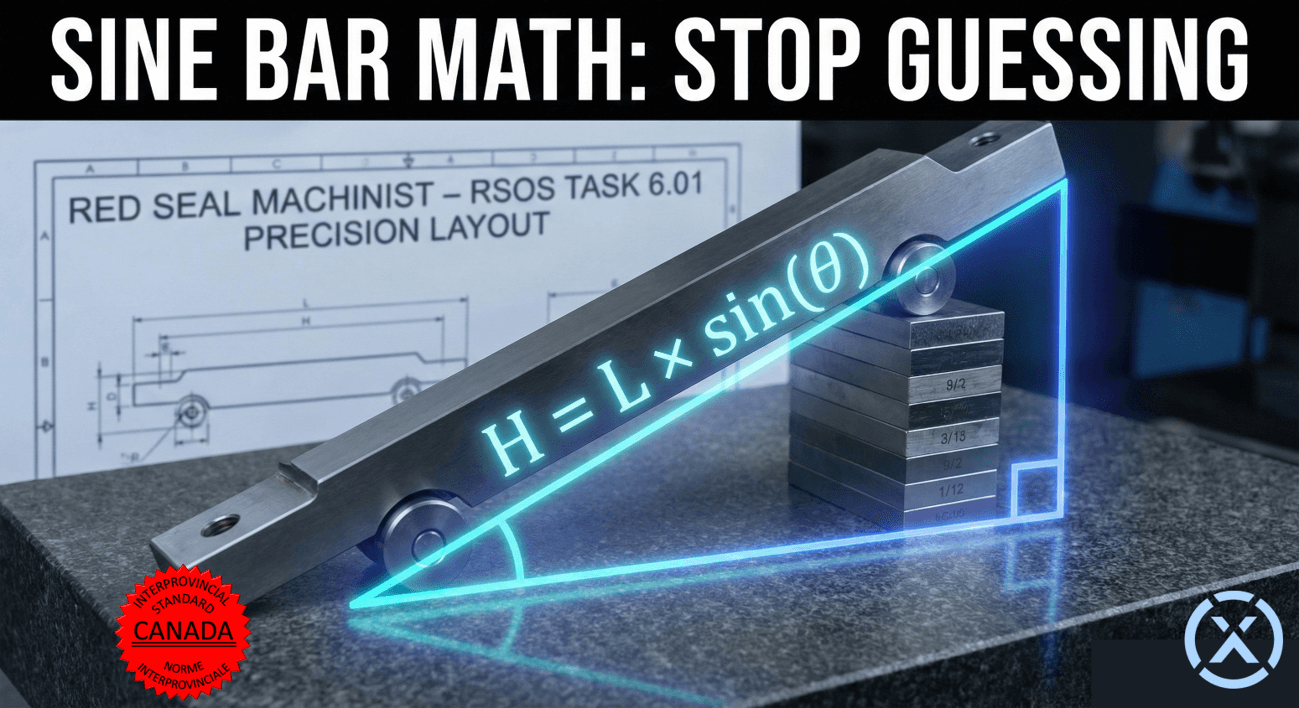
A sine bar is simply a physical representation of a right-angle triangle. Understanding this geometry is the only way to solve these questions without a reference chart.
The Trigonometry of the Sine Bar The Red Seal exam focuses on RSOS Task 6.01 (Performs Layout) and Task 16.03 (Sets up work holding devices for precision grinding machines). Both tasks require you to calculate the stack height of gauge blocks to set a precise angle.
Here is the logic you need to visualize:
- The Sine Bar is always the Hypotenuse (Long side).
- The Gauge Block Stack is always the Opposite side (Height).
- The Surface Plate is the Adjacent side.
Because you know the Hypotenuse (the bar length) and the Angle (from the print), you use the Sine function.
The Formula: H = L × sin(θ)
-
H: Height of Gauge Blocks (Opposite)
-
L: Length of Sine Bar (Hypotenuse)
-
θ: The desired Angle
Example Calculation: You need to set up a 30° angle using a 5-inch sine bar.
-
Find the Sine: Enter
30and hitsinon your calculator. Result: 0.5 -
Multiply by Length: 5 inches × 0.5
-
Result: 2.5000 inches
You would build a gauge block stack of exactly 2.5000 inches.
Standard Sine Bar Constants
The exam will typically use standard sizes. Memorize these constants to speed up your math.

Red Seal Radar This topic appears as a Calculation question.
-
The Trap: The exam may give you the angle in Degrees and Minutes (e.g., 30° 15′).
-
The Fix: You must convert minutes to decimals before calculating the sine. Divide the minutes by 60.
-
Example: 30° 15′ = 30 + (15 ÷ 60) = 30.25°. Use 30.25 in your sine calculation.
Book vs. Reality
On the Job: You rely on reference tables or constants stored in memory to ensure speed and eliminate calculation errors. You trust the tool’s geometry and your indicators.
On the Exam: The exam tests the theory behind the chart. If you do not know that H = L × sin(θ), you cannot answer the question. The test isn’t checking if you can look up a number; it’s checking if you understand the trigonometric relationship between the bar length and the stack height.
Machinist Exam Curveballs: FAQ
Q: How do I calculate stack height for a metric sine bar on the Canadian Red Seal exam? A: Use the standard formula H = L × sin(Angle) using the bar length in millimetres. For a 200 mm sine bar at 30°, the calculation is 200 × 0.5 = 100 mm.
Q: What is the maximum practical angle for a sine bar? A: The Red Seal standard typically considers 45° to 60° the maximum effective range. Beyond 60°, the sine curve flattens out, meaning a tiny error in stack height results in a significant error in the angle, reducing stability and accuracy.
Q: Can I use a sine bar to measure an unknown angle? A: Yes, by reversing the formula to sin(Angle) = H ÷ L. Measure the stack height required to make the part level, divide that height by the length of the bar, and use the inverse sine (sin⁻¹) function on your calculator to find the angle.
The Tailgate Checklist
-
Hypotenuse is the Bar: The length of the sine bar (5″, 10″, 100mm, 200mm) is always the diagonal side.
-
Formula: Stack Height = Bar Length × Sine of the Angle.
-
Convert Minutes: Always convert degrees/minutes to decimal degrees (15′ = 0.25°, 30′ = 0.5°, 45′ = 0.75°) before calculating.
-
Precision: Standard practice requires accuracy to four decimal places.
-
Key Takeaway: Success on the Red Seal depends on mastering these machinist exam formulas so you don’t need a chart.
Don’t leave your certification to chance. Join the thousands of Canadians who have passed with XLR8ed Learning. Turn your coffee break into a study session with our mobile-optimized, 5-minute quizzes covering Recall, Diagnostic, and Calculation questions at xlr8edlearning.ca.