
2026 Guide to Red Seal Exam Multiple Choice Questions
For Red Seal Trade apprentices preparing for certification exams, mastering multiple choice question strategy is essential for achieving passing scores. This begins with understanding the basic construction of a multiple-choice question.
TL;DR
Red Seal questions (MCQ) success is mostly process:
-
Understand the anatomy: stem + context + options (key, distractors, outlier).
-
Read the stem like a technical drawing: find the task verb, constraints (MAX/MIN/first/before), and watch for NOT/EXCEPT.
-
Predict your answer before looking to avoid getting pulled into a slick distractor.
-
Eliminate strategically: knock out outliers, “true but irrelevant” options, unit/scale mismatches, and absolute-language traps.
-
When two seem right, pick the “most correct”: safest, code/standard-aligned, and consistent with manufacturer instructions.
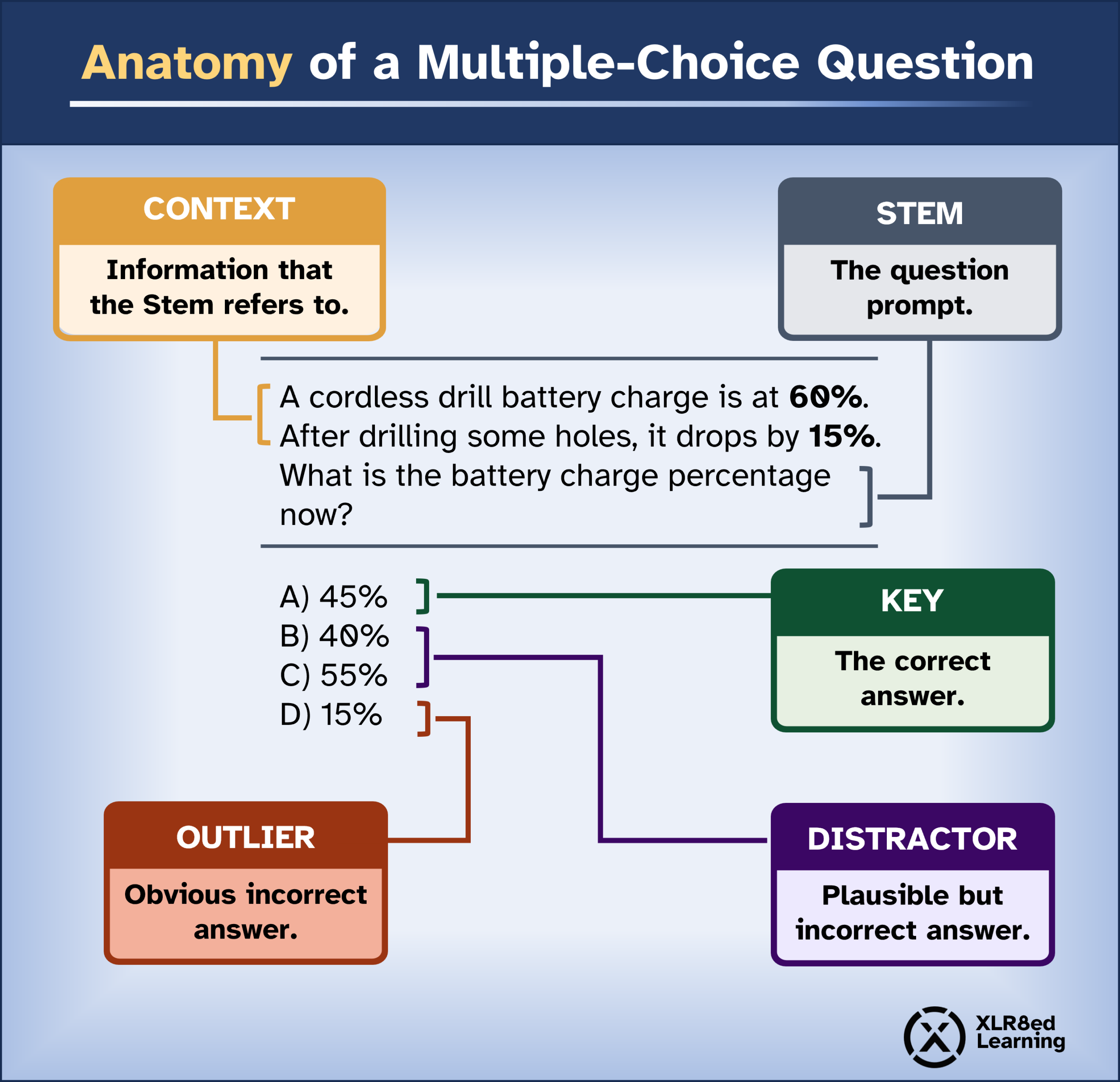
Anatomy of a Multiple-Choice Red Seal Question

Generally, Red Seal exam questions are made up of two main components: the question and the answer options.
Question Components
Stem – The prompt (the ask) or task being required.
Context – Information needed to answer the question. Information can be in the form of a scenario, raw data, diagram, etc. Sometimes context has extra information that has no bearing on the question.
Answer Options
Key – The correct answer: the one best, unambiguously correct answer choice—accurate, clearly supported by the stem’s information, and the option a well-prepared learner should select.
Distractor – An incorrect but plausible answer choice designed to tempt someone who misunderstands the concept or makes a common error. This helps the question discriminate between those who truly know the material and those who don’t.
Outlier – A clearly incorrect “throwaway” choice that doesn’t reasonably fit the question—often mismatched in value, unit, or idea—so it stands out as obviously wrong compared to the correct answer and the distractors.
Once the structure of multiple-choice questions is understood, the strategy to effectively answer them can be broken down into three parts.
Part 1: Reading and Analyzing a Red Seal Question
To avoid misreading, treat the stem (the question part) like a technical drawing: every detail matters.
The “Cover-Up” Method – Read the stem and try to answer it in your head before looking at the options. This prevents being biased by a convincing distractor.
Read the Last Sentence First – Long word problems often contain fluff. Reading the actual question at the end first helps you filter out unnecessary information in the preamble.
Identify the Task or “Action” Verb – Look for words like calculate, identify, install, or troubleshoot. This tells you whether the question is asking for a procedure, a fact, or a calculation.
Watch for Negative Wording (Exceptions) – These words flip the logic of the question. Instead of looking for the correct answer, you are looking for the one that is incorrect or does not fit.
- NOT: “Which of the following is NOT a required safety procedure?”
- EXCEPT: “All of the following are conductors EXCEPT…”
- BUT: “The motor will run under these conditions BUT…”
- NEVER / UNACCEPTABLE: “Which practice is NEVER permitted when working on live circuits?”
Find Constraint Keywords – Look for specifics like Maximum, Minimum, Initial, or Final. These usually point directly to a specific Code requirement.
- Time & Sequence (When) – These keywords limit the answer to a specific phase of a process.
– Initial / First: “What is the initial step in troubleshooting …?”
– Prior to / Before: “What must be done prior to opening …?”
– During: “Which safety PPE is required during …?” - Physical & Environmental Conditions (Where/What) – These limit the answer based on the surroundings or materials.
– Wet / Damp: “Which …. type is required in a wet location?”
– Residential / Commercial / Industrial: “According to code, what is …?”
– Energized / Live: “Which …. is permitted for use on energized equipment?”
– Outdoor / Indoor: “When operating outdoors exposed to sunlight which …?” - Quantities & Limits (How Much) – These set numerical or logical boundaries.
– Maximum / Minimum: “What is the maximum number of ….?”
– At least: “The …. must have at least …”
– Exceeding: “For equipment exceeding …?” - Conditional (If/Unless) – These create a branch in the logic where the standard rule might change.
– Unless: “All …. equipment must … unless they are not readily accessible.”
– Provided that: “…… may be used provided that ….”
Scan for Units, Decimal Places, Conditions, and State
- Units: V, A, Ω, PSI, mm, °C, torque, flow rate
- Decimal places: key when calculating and working with metric units
- State: “energized/de-energized,” “running/stopped,” “open/closed,” “loaded/unloaded”
- Many wrong answers are correct in another condition
Spot What Kind of Question It Is
- Recall: definition/fact
- Application: use a rule/standard
- Procedural: steps required to accomplish a task
- Troubleshooting: symptom/cause/test/action
- Calculation: compute then match
- Strategy shifts: troubleshooting = eliminate by mechanism; calculation = eliminate by units/scale
Predict the Answer Before Looking at the Answer Options
- Even a rough prediction helps you spot distractors and reduces “option hypnosis.”
Part 2: Eliminating Red Seal Question Distractors
Red Seal exams use plausible distractors—answers that are true in one context but wrong for the specific question asked.
Eliminate Outliers First – If three answers are numbers in a similar range and one is drastically different; the outlier is often (though not always) an easy first elimination.
Eliminate “True but Irrelevant” Options – Many distractors are factually true statements or Code rules, but they don’t answer the specific question being asked.
Look for Opposite Pairs – If two answer options are direct opposites (e.g., increase vs. decrease), there is a high probability that one of them is correct.
Watch for the “Umbrella” Option – If one answer is broad and another is specific but included within the broad one, the broader answer is often the “most correct.”
Be Cautious with Absolutes – Options containing always, never, or all are rarely correct in trades unless the domain truly supports them.
Check Each Option Against the Question’s Qualifiers
- If the question asks, “MOST likely” and an option is “possible but rare,” eliminate it.
- If it asks “FIRST,” eliminate actions that are later-stage fixes.
Use Dimension/Unit Sanity Checks
- For calculations: wrong units, wrong order of magnitude, or wrong sign/direction is an easy elimination.
- Even without full math, you can rule out nonsense.
Ignore “Story Fluff”; Focus on What Changes the Decision
- Long scenario questions may contain extra description to simulate real jobs; underline only details that affect the decision (measurements, defects, codes, sequence).
- Mentally strip the stem to the essentials: “Given X condition and Y reading, what is the correct next step?”
- Cross out unnecessary information.
Beware of Word-for-Word Repetition
- Answers that repeat exact phrases from the question are often wrong. Correct choices typically paraphrase concepts rather than mirror the question’s language.
Know That Red Seal Questions Are Not Trick Questions
- Red Seal exams are multiple choice with one correct answer and three plausible distractors; they are not designed to mislead competent candidates.
- Treat questions as straightforward checks of real-world knowledge, not puzzles where you must “outsmart” the examiner.
Part 3: Selecting the “Most Correct” Answer
With the Red Seal exam, you aren’t just looking for a right answer—you’re looking for the best one according to national standards.
Safety First – If two answers seem correct, but one involves a higher level of safety or follows OHSA/PPE protocols more strictly, choose the safer option.
Manufacturer’s Specs Tie-Breaker – When in doubt, the Red Seal exam default is usually: follow the manufacturer’s instructions or follow the Code.
Avoid Regionalisms – Answer according to the National Code/Standard, not local field shortcuts.
Trust Your First Choice (Unless You Can Prove It Wrong)
- Keep your first selection unless you find a specific reason to change it (misread word, missed constraint, unit mismatch, or calculation check).
Choose the Option That Best Matches the Test-Maker’s Goal
- Red Seal questions often reward safety first, standard procedure, correct sequence, and verification before replacement.
- If two are technically correct, pick the one aligned with these priorities.
- When options look similar, choose the one that maximizes safety, meets code/standard requirements, and reflects standard industry practice.
- Distractors often omit a safety step (PPE, lockout/tagout, testing) or violate a basic manufacturer or code instruction.
When Stuck Between Two: Use the “Covers More / Violates Less” Test
- Explains more of the scenario with fewer assumptions, OR
- Violates fewer constraints (safety, code, sequence, measurement evidence).
Procedural Red Seal Questions: Answer Option Ranking
- Usually involves procedures of 4 to 6 steps.
- Procedural Red Seal questions include safety steps most of the time.
- One option will be an “Outlier” – obviously incorrect for safety or technical reasons.
- Next remaining three will often have one where it includes the correct safety steps but out of order.
- The remaining two will be very close with one slightly more correct than the other.
Red Seal multiple choice marks often come down to one thing: a repeatable method. Read the stem like a blueprint. Find the action verb, then spot NOT/EXCEPT and any limits like MAX, MIN, or FIRST.
Before you look at the options, predict your answer. Then cross off outliers and choices that are true but don’t fit the question. If you’re stuck between two, pick the safer option and the one that follows the manufacturer and the national code. Practice this process on timed questions until it feels automatic.
Start Practicing Red Seal Questions with XLR8ed Learning
FAQs
1) What is the best strategy for Red Seal questions (MCQ)?
Use a repeatable workflow: analyze the stem, predict the answer, then eliminate distractors before choosing the most correct option.
2) What are “key,” “distractor,” and “outlier” answers?
The key is the single best correct answer, a distractor is a plausible wrong choice, and an outlier is an obviously wrong “throwaway” option.
3) What is the “cover-up method” for multiple choice exams?
Read the stem and answer in your head before viewing options to prevent a convincing distractor from biasing you.
4) Why read the last sentence of a Red Seal question first?
Because long scenarios often include fluff; the last sentence usually contains the actual task, helping you filter the context faster.
5) What words should I watch for in Red Seal questions?
Look for action verbs (calculate, identify, troubleshoot) and constraint keywords (maximum/minimum, first/initial, prior to, during, unless, provided that).
6) How do I handle NOT / EXCEPT / NEVER questions?
Slow down and flip your logic: you’re not hunting the correct statement—you’re hunting the one that doesn’t fit the rule or requirement.
7) How do I eliminate distractors on Red Seal exams?
Start with outliers, then remove options that are true but irrelevant, don’t match the stem’s qualifiers (MOST likely, FIRST, etc.), or fail unit/scale checks.
8) What are “opposite pair” answers and why do they matter?
If two options are direct opposites (increase vs decrease), there’s a good chance one is correct—use stem constraints to pick the one that fits.
9) What is an “umbrella option” in multiple choice?
When one option is broader and another is a subset, the broader “umbrella” choice is often the most correct (unless the stem asks for a specific case).
10) Are Red Seal questions trick questions?
Generally no—assume they test real-world competency with one best answer, not riddles. The traps are usually misreads and missed constraints.
11) How do I choose the “most correct” answer if two seem right?
Use tie-breakers: safety first, then manufacturer instructions, then national code/standard alignment (not local shortcuts).
12) What’s the fastest way to catch calculation mistakes without doing full math?
Do “sanity checks”: confirm units, order of magnitude, decimal placement, and whether the direction/sign makes sense for the scenario.