
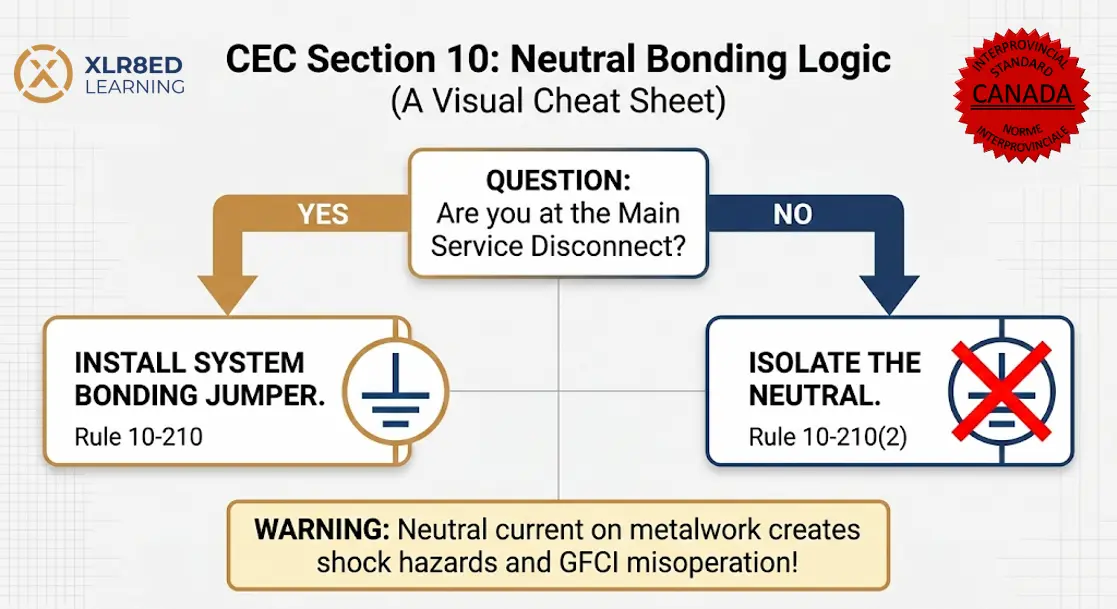
Electrical Bonding Exam Questions: The Neutral Trap
The “Challenger” Trap: Why Your Shop Habits Will Fail You
You’ve been on the tools for years. You know that grounding and bonding keep people alive. In CEC land, bonding all non-current-carrying metal is always the goal—the trap is the neutral-bond-it-everywhere instinct. Electrical bonding exam questions questions, that shop habit is the fastest way to get a Section 10 question wrong.
In the field, you might see sub-panel installs where the neutral and ground are tied together. On the exam, this is a critical code violation. If you treat a sub-panel like a service entrance, you create parallel paths for normal return current, turning your raceways and enclosures into unintended conductors.
Electrical Bonding Exam Questions
To successfully answer CEC Section 10 exam questions, you must use the correct terminology. You are dealing with the grounding connection (connecting the system grounded conductor to earth) and the system bonding jumper (the specific neutral-to-equipment connection at the permitted location).
Featured Snippet: CEC Rule 10-210 requires the grounded (neutral) conductor of a solidly grounded system supplied by the supply authority to be connected to ground at one point only at the consumer’s service. It must have no other connection to metal parts on the supply or load side. (Note: Different rules can apply for separately derived systems like certain transformer secondaries or generators).
This fundamental concept aligns with RSOS Major Work Activity B, specifically Task B-7 (Services) and Task B-11 (Grounding and Bonding).
Red Seal Radar
The Red Seal exam uses Diagnostic and Procedural questions to test this. They won’t just ask for a rule number; they will describe a scenario where enclosures are developing stray voltage or a GFCI is nuisance tripping. If the neutral is bonded in a sub-panel, the exam-correct answer is that you have created a “parallel path for normal neutral current.”
Book vs. Reality: The Parallel Path Problem
On the job, it’s easy to think “it all goes to ground eventually.” But for the exam, you must understand the “Why.” If you install a neutral-to-ground bond in a sub-panel, those metal parts now carry normal return current. They are no longer purely fault-current paths. This creates objectionable current on metalwork, leading to shock hazards and interfering with the operation of protective devices.
Exam Curveballs
Q: Where is the neutral grounded in a Canadian residential service according to the Red Seal exam?
A: The neutral must be grounded at the main service box only, specifically at the point where the consumer’s service connects to the supply authority’s system, as per CEC Rule 10-210.
Q: What happens if a neutral-to-ground bond is installed in a sub-panel?
A: This creates a parallel path for normal neutral current, which can lead to unbalanced currents that bypass a GFCI’s sensor, causing nuisance trips or failure to trip under fault conditions.
Q: Is the “Bond at the service, isolate everywhere else” rule always true?
A: For a standard solidly grounded service, yes; however, always check if the question specifies a “separately derived system,” such as a transformer secondary, where different rules for the bonding point may apply.
The Tailgate Checklist
-
The Exam Rule: Bond the neutral at the service only; keep it isolated in sub-panels.
-
Terminology Check: Use “System Bonding Jumper” for the neutral-to-ground connection.
-
Identify the Source: If the question mentions a “Remote Distribution Centre,” the neutral must be isolated from the enclosure.
-
Watch for Exceptions: Separately derived systems (transformers) are the primary exception to the “one point only” service rule.
Don’t leave your certification to chance.
XLR8ed Learning offers a Commitment to Completion (C2C) Plan. We provide 10 weeks of initial access to our mobile-optimized quizzes and lessons. If you are unsuccessful with your exam attempt, we provide you 4 weeks of access prior to each additionally required exam attempt at no charge. Visit xlr8edlearning.ca today.